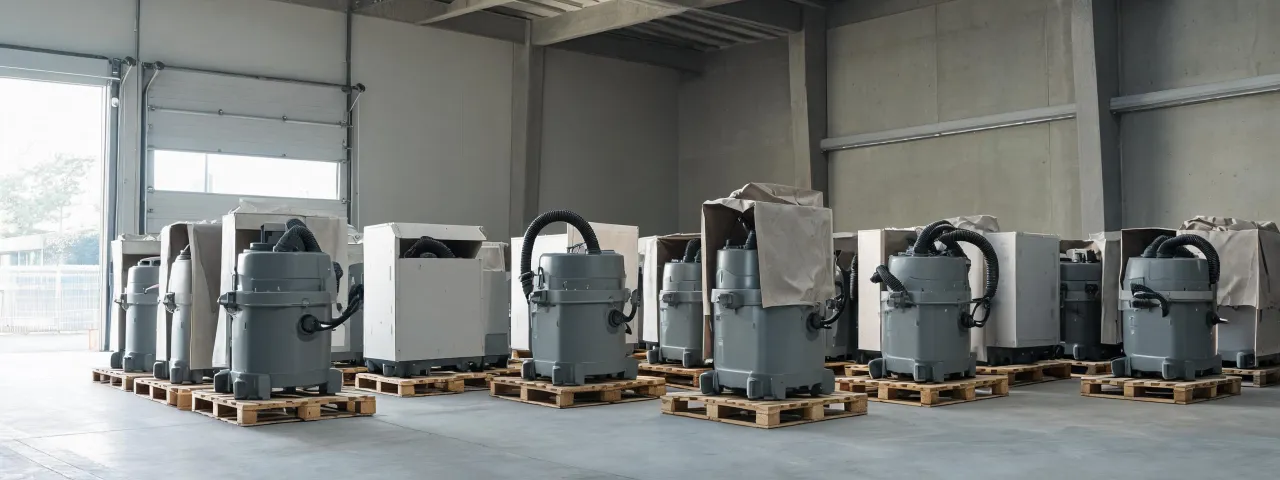
Industrial Vacuums is the family this release stays inside
Dry aisle vacuums
Inquiry range: walk-behind or canister machines for dry fines on sealed floors. Confirm cleaning path, filter class, and cord or battery. Do not treat a published square-foot rate as throughput until tool width and speed are stated. Stock is not implied by a row on this page.
Wet or wet-dry pick-up
Inquiry range: machines whose tank and switch are described for liquid. Confirm tank material, float or shutoff, and whether the same filter is used for dry days. A photo of water in a drum is not a specification. The supplier names the model that includes the shutoff.
Chip and debris collection at a bench or aisle
Inquiry range: higher vacuum or a larger hose for chips, still inside an industrial vacuum rather than a central collector duct. Confirm inlet diameter, grounding notes, and the dump method. Ambient temperature and ingress protection stay open until the datasheet for that model arrives.
Two trade-offs wholesale buyers keep meeting
Lowest equipment price and comparable lifecycle scope
A lower machine price can reduce the capital line when filters, tools, freight, training, and the Incoterm truly match. The other reading is delivered cost: bags, cartridges, and a second hose show up after the first month. Ask both numbers to be visible. This site does not declare which reading wins for your plant.
Headline airflow and a stated test basis
A large CFM figure is a useful screen. It becomes a purchase input when the hose diameter, the orifice, and the motor condition are written beside it. Two wholesale offers with different hoses are not the same machine at two prices. Record the specification deviation instead of averaging the airflow.
Standard configuration can shorten the document set when the floor tool and voltage already match the site. An application-specific tool, a longer hose, or a different wheel is reasonable when the aisle or the debris demands it, and it should be priced as its own line. Neither choice is assumed here.
How to repeat an airflow and noise check
Use one setup for every offer. Fit the hose inside diameter you will actually buy, such as 38 mm or 50 mm. Start with a clean filter. Power the machine at the site voltage, for example 230 V, 60 Hz, single phase, and record full-load current. Read airflow in m3/h or CFM at the orifice the supplier names, and read noise level in dB(A) at 1.0 m with the floor tool on. Write the ambient temperature if the sheet includes it. If a supplier used 1.5 m or a bare inlet, that row is a specification deviation, not a second copy of the same test.
Three configurations, four comparison lines
A walk-behind dry vacuum, a wet-dry drum, and a chip vacuum with a larger inlet are three inquiry shapes, not three confirmed models. Compare them on airflow test basis, noise distance, filtration consumables, and crate plus Incoterm. A dry unit may show a higher headline CFM on a short hose and still miss a wet shutoff. A drum may hold 80 L and need two people to dump. A chip unit may need a 50 mm or 70 mm inlet and a grounding note the dry unit never had. Count those as different delivered costs. Do not average them into one wholesale unit price.
See heavy duty labels and how offers are normalized. Noise-sensitive halls should pass through the Buyer Checklist. The procurement brief carries the field list, and the contact form is where the quantity is submitted.